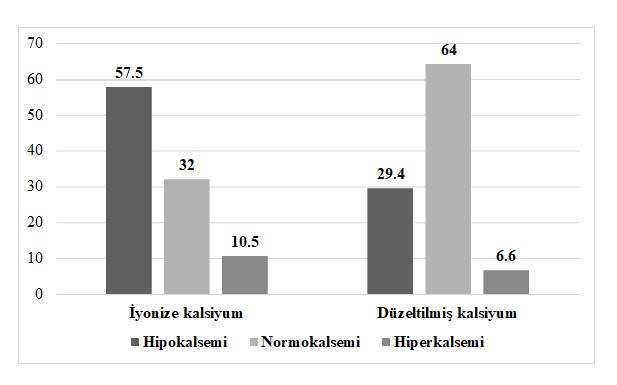
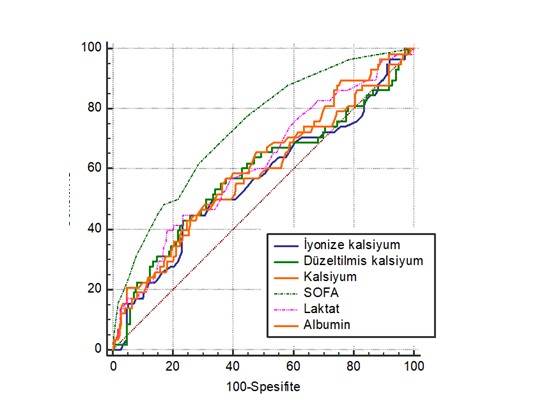
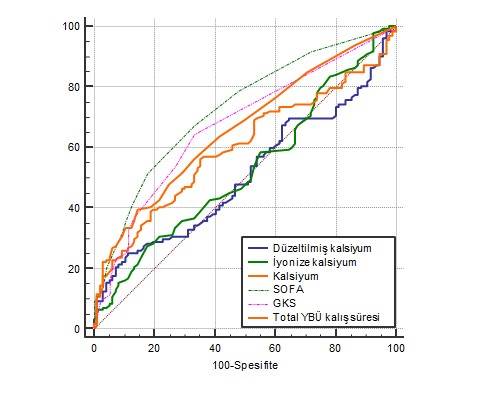
Objective Calcium plays an important role in almost all cellular processes. Measurement of ionized calcium levels is more important in demonstrating calcium metabolism. Tight control of calcium metabolism is impaired during sepsis. However, the prognostic significance of ionized calcium levels in patients admitted to the intensive care unit (ICU) due to sepsis is not fully known. The aim of our study was to evaluate the prognostic significance of ionized calcium levels in patients admitted to the ICU due to sepsis. Material and methods A total of 228 patients who were admitted to the emergency department of the university Faculty of Medicine and admitted to the emergency ICU with a diagnosis of sepsis between January 2020 and December 2021 were included in the study. Demographic characteristics, vital signs, Sequential Organ Failure Assessment (SOFA), Rapid Sequential Organ Failure Assessment (qSOFA), ionized calcium and total serum calcium levels, blood gas, hemogram and biochemistry parameters, hospital outcome, and 7-day mortality status were retrospectively screened and analyzed. Results The mean ionized calcium level of the cases was 1.07 ± 0.20 mmol/L, and the albumin-corrected calcium level was 9.20 ± 1.06 mg/dL. While the 7-day mortality rate was 25.4%, the hospital mortality rate was up to 57.9%. ROC analyses showed that ionized calcium concentrations were not the sole predictors of 7-day mortality (AUC=0.561, 95% CI 0.494-0.626, p=0.188) and hospital outcome (AUC=0.525, 95% CI 0.458-0.591, p=0.517). Ionized calcium levels were also not correlated with SOFA score, ICU length of stay, and hospital length of stay, which were significant predictors of mortality. Conclusion Ionized calcium may provide more accurate information than corrected total serum calcium levels in determining calcium levels. The frequency of hypocalcemia is quite high in sepsis cases. However, the prognostic value of ionized calcium is limited in patients admitted to the ICU due to sepsis.
Conflict of interest : The authors declare that they have no conflict of interest.
Mevlana Tıp Bilimleri 2025, Vol5, Issue3 E-ISSN: 2757-976X
Received : , Accepted : , Published Online :
References
1. Gauer R, Forbes D, Boyer N. Sepsis: Diagnosis and Management. Am Fam Physician. 2020;101(7):409-18.
2. Rhodes A, Evans LE, Alhazzani W, et al. Surviving Sepsis Campaign: international guidelines for management of sepsis and septic shock: 2016. Crit Care Med 2017; 45: 486– 552.
3. Cunha BA. Sepsis and septic shock: selection of empiric antimicrobial therapy. Crit Care Clin. 2008;24(2):313-34.
4. Harris RL, Musher DM, Bloom K, et al. Manifestations of sepsis. Arch Intern Med. 1987;147(11):1895-906.
5. Baird GS. Ionized calcium. Clin Chim Acta. 2011;412(9-10):696-701.
6. Aberegg SK. Ionized Calcium in the ICU: Should It Be Measured and Corrected? Chest. 2016;149(3):846-55.
7. Egi M, Kim I, Nichol A, et al. Ionized calcium concentration and outcome in critical illness. Crit. Care Med. 2011;39(2):314-21.
8. Zhang Z, Xu X, Ni H, Deng H. Predictive value of ionized calcium in critically ill patients: an analysis of a large clinical database MIMIC II. PLoS One. 2014;9(4):e95204.
9. Sanaie S, Mahmoodpoor A, Hamishehkar H, et al. Association Between Disease Severity and Calcium Concentration in Critically Ill Patients Admitted to Intensive Care Unit. Anesth Pain Med. 2018;8(1):57583.
10. Cekmen B, Koylu R, Akilli NB, Atis SE. Ionized calcium level predicts in-hospital mortality of severe sepsis patients: A retrospective cross-sectional study. J Acute Dis. 2021; 10(6): 247-51.
11. Zivin JR, Gooley T, Zager RA, Ryan MJ. Hypocalcemia: a pervasive metabolic abnormality in the critically ill. Am J Kidney Dis. 2001;37(4):689–98.
12. Zaloga GP. Ionized hypocalcemia during sepsis. Crit Care Med. 2000;28(1):266-8.
13. Zaloga GP. Hypocalcemia in critically ill patients. Crit Care Med. 1992;17:251–62.
14. He W, Huang L, Luo H, et al. The Positive and Negative Effects of Calcium Supplementation on Mortality in Septic ICU Patients Depend on Disease Severity: A Retrospective Study from the MIMIC-III. Crit Care Res Pract. 2022; 2022:2520695.
15. Iqbal M, Rehmani R, Hijazi M, Abdulaziz A, Kashif S. Hypocalcemia in a Saudi intensive care unit. Ann Thorac Med. 2008;3(2):57-9.
16. Slomp J, van der Voort PH, Gerritsen RT, Berk JA, Bakker AJ. Albumin-adjusted calcium is not suitable for diagnosis of hyperand hypocalcemia in the critically ill. Crit Care Med. 2003;31(5): 1389-93.
17. Byrnes MC, Huynh K, Helmer SD, et al. A comparison of corrected serum calcium levels to ionized calcium levels among critically ill surgical patients. Am J Surg. 2005;189(3):310-4.
18. Grzych G, Pekar JD, Durand G, et al. Albumin-Adjusted Calcium and Ionized Calcium for Assessing Calcium Status in Hospitalized Patients. Clin Chem. 2019;65(5):703-5.
19. Fei M, Li P, Tao X, Pan A, Wang J. Influence of hypocalcemia on the prognosis of septic patients. Zhonghua Wei Zhong Bing Ji Jiu Yi Xue. 2019; 31(4):418-21.
 Research Article
 View as PDF
 KeywordsIonized Calcium, Corrected Calcium, Sepsis, Intensive Care Unit