Abdullah Güner,ÖMER TANYELİ,Yüksel DERELİ

  • Abdullah Güner: KONYA ŞEHİR HASTANESİ
  • ÖMER TANYELİ: NECMETTİN ERBAKAN ÜNİVERSİTESİ
  • Yüksel DERELİ: NECMETTİN ERBAKAN ÜNİVERSİTESİ Meram Tıp Fakültesi
  •  Year : 2024
  •  Vol : 4
  •  Issue : 3
  •  Page : 139-142
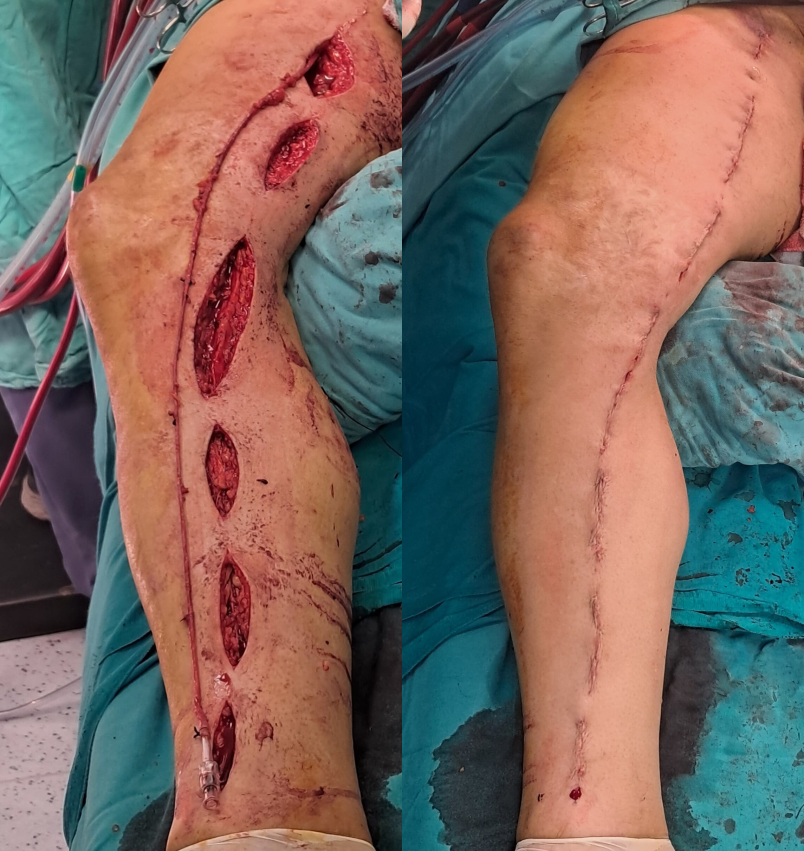
Objective: Coronary heart disease (CHD) is a common health problem worldwide and coronary bypass grafting (CABG) is an important alternative treatment modality. The vena saphena magna (VSM) graft can be prepared with the classical method and multiple minimal skin incisions. We aimed to investigate the early results of patients undergoing coronary bypass grafting with the classical method and multiple minimal skin incisions during VSM graft preparation.
Methods: Between 2023 and 2024, 80 patients who underwent elective CABG were included in the study. Patients were divided into two groups: classical VSM preparation method (n=40) and multiple minimal skin incision method (n=40). Demographic data, comorbidities, intraoperative cardiopulmonary bypass (CPB) time, cross clamp (X clamp) time, wound site infection, postoperative intensive care unit (ICU) and total hospitalization time were evaluated in both groups.
Results: There was no significant difference between the two groups in terms of age, gender, comorbidities, cardiopulmonary bypass and cross clamp time. Wound infection rates were observed at 12.5% in the conventional method group and 5% in the multiple minimal incision group, though this difference was not statistically significant (p=0.235). Furthermore, there were no notable differences in the lengths of stay in the intensive care unit or the total hospital stay (p=0.625, p=0.129).
Conclusion: The early outcomes of VSM preparation with the classical technique compared to multiple minimal skin incisions indicated a lower rate of wound infections with the latter method; however, this difference did not achieve statistical significance.
Cite this Article As : Güner A, Tanyeli Ö, Dereli Y. Koroner Bypass Cerrahisinde Safen Ven Greft Hazırlığı: Minimal Multiple Cilt İnsizyonunun Etkisi. Mev Med Sci. 2024; 4(3): 139-142

Conflict of interest : The authors declare that they have no conflict of interest.

This article is published under the CC BY-NC 4.0 license.
Mevlana Tıp Bilimleri
2024, Vol4, Issue3
E-ISSN: 2757-976X
Received : , Accepted : , Published Online :

References

  1. 1. DERELİ Y. Open heart surgery in Konya state hospital: review of the first 550 cases. Selçuk Tıp Dergisi. 2013;30(2):58-63.
  2. 2. GÖRMÜŞ N, DURGUT K, ORHAN A, YÜKSEK T. Sol ana koroner arter oklüzyonu nedeni ile acil açık kalp cerrahisi uygulanan hastalardaki erken ve orta dönem sonuçlarımız. Selçuk Tıp Dergisi. 2005;21(1).
  3. 3. Cooper G, Underwood M, Deverall P. Arterial and venous conduits for coronary artery bypass. A current review. European Journal of Cardio-thoracic Surgery: Official Journal of the European Association for Cardio-thoracic Surgery. 1996;10(2):129-40. https://doi.org/10.1016/S1010-7940(96)80135-7
  4. 4. Mills NL, Everson CT. Vein graft failure. Current Opinion in Cardiology. 1995;10(6):562-8. https://doi.org/10.1097/00001573-99511000-00003
  5. 5. Chen ZG, Chen YX, Diao YP, Wu ZY, Yan S, Ma L, et al. Simultaneous multi-supra-aortic artery bypass successfully implemented in 17 patients with type I Takayasu arteritis. European Journal of Vascular and Endovascular Surgery. 2018;56(6):903-9. https://doi.org/10.1016/j.ejvs.2018.08.044
  6. 6. Khan SZ, Rivero M, McCraith B, Harris LM, Dryjski ML, Dosluoglu HH. Endoscopic vein harvest does not negatively affect patency of great saphenous vein lower extremity bypass. Journal of Vascular Surgery. 2016;63(6):1546-54. https://doi.org/10.1016/j.jvs.2016.01.032
  7. 7. Athanasiou T, Aziz O, Skapinakis P, Perunovic B, Hart J, Crossman M-C, et al. Leg wound infection after coronary artery bypass grafting: a meta-analysis comparing minimally invasive versus conventional vein harvesting. The Annals of thoracic surgery. 2003;76(6):2141-6. https://doi.org/10.1016/s0003-4975(03)01435-8
  8. 8. Hassoun-Kheir N, Hasid I, Bozhko M, Shaban Z, Glam R, Hussein K, et al. Risk factors for limb surgical site infection following coronary artery bypass graft using open great saphenous vein harvesting: a retrospective cohort study. Interactive CardioVascular and Thoracic Surgery. 2018;27(4):530-5. https://doi.org/10.1093/icvts/ivy137
  9. 9. Zhang S-Z, Wang G-X, Zhou X-T. The clinical application of microincision vein harvesting of the great saphenous vein in coronary artery bypass grafting. BMC Cardiovascular Disorders. 2020;20:1-7. https://doi.org/10.1186/s12872-020-01555-5
  10. 10. Vuong NL, Elfaituri MK, Eldoadoa M, Karimzadeh S, Mokhtar MA, Eid PS, et al. Saphenous vein harvesting techniques for coronary artery bypass grafting: a systematic review and meta-analysis. Coronary Artery Disease. 2022;33(2):128-36. https://doi.org/10.1097/MCA.0000000000001048
  11. 11. Şen O, Kadiroğulları E. Koroner bypass operasyonlarında safen ven grefti hazırlama tekniklerinin karşılaştırılması. Turkish Journal of Clinics and Laboratory. 2018;9(2):110-3. https://doi.org/10.18663/tjcl.401753
  12. 12. Šimek M, Nemec P, Bruk V, Gwozdziewicz M, Fluger I, Langova K. Postoperative and midterm outcomes of minimally invasive and endoscopic great saphenous vein harvesting for coronary artery bypass grafting-a prospective analysis. The Thoracic and cardiovascular surgeon. 2007;55(07):428-32. https://doi.org/10.1055/s-2007-965325
  13. 13. Krishnamoorthy B, Critchley WR, Glover AT, Nair J, Jones MT, Waterworth PD, et al. A randomized study comparing three groups of vein harvesting methods for coronary artery bypass grafting: endoscopic harvest versus standard bridging and open techniques. Interactive cardiovascular and thoracic surgery. 2012;15(2):224-8. https://doi.org/10.1093/icvts/ivs164