ABSTRACT
Aim: This study aims to investigate and evaluate the relationship between quality of life and its subgroups in individuals aged 65 and older with mild cognitive impairment (MCI) and without MCI.
Materials and Methods: A total of 109 volunteers aged 65-97 participated in our study. The Montreal Cognitive Assessment Scale (MoCA) and the World Health Organization Quality of Life Scale / Older Adults Module (WHOQOL/OLD) were applied.
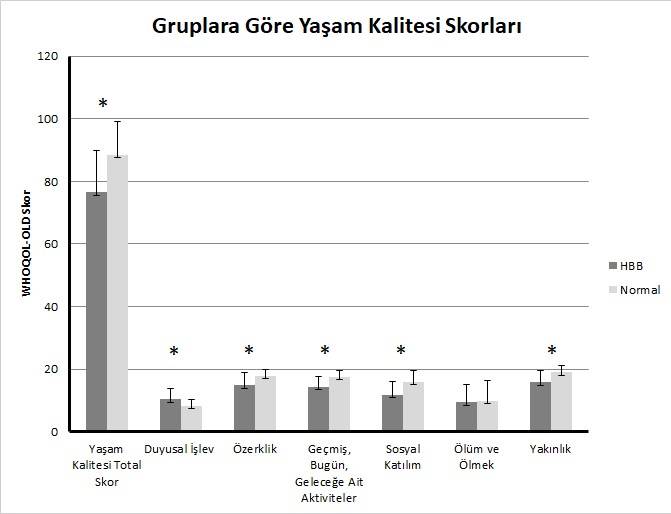
Results: The relationship between total score of MoCA and WHOQOL/OLD scale is significant and moderate across groups (r= .567, p<0.01). In the MCI group, compared to those without MCI, no difference was found in the death and dying subcategory of WHOQOL/OLD, while scores were higher in the sensory functions subgroup and lower in the autonomy, social participation, past present-future activities, and intimacy subgroups (respectively; t=-,392, p=,696, t=-4,784, t=3,541 t=-4,319, t=-5,173, t=-5,568, p<0.001).
Conclusion: Our study revealed that the decline in cognitive levels in elderly individuals negatively affects their perception of quality of life. We believe that our results will contribute to the development of programs aimed at slowing down the physiological decline in mental functions during the aging process. Subsequent research should be designed to implement enriching cognitive programs and activities.
Cite this Article As : Kılıç P, Aydın L, Yılmaz B, Sılay K. 65 Yaş ve Üstü Bireylerde Bilişsel Fonksiyonlar ile Yaşam Kalitesi Algisi Arasindaki İlişkinin İncelenmesi. Mev Med Sci. 2023;3(3):125-131
Conflict of interest : The authors declare that they have no conflict of interest.
Mevlana Tıp Bilimleri 2023, Vol3, Issue3 E-ISSN: 2757-976X
Received : , Accepted : , Published Online :
References
1. DSÖ. “Ageing and Health.” World Health Organization: https://www.who.int/news-room/fact-sheets/detail/ageing-and-health. 1 Ekim 2022.
2. TÜİK. İstatistiklerle Yaşlılar, 2022. https://data.tuik.gov.tr/Bulten/Index?p= Istatistiklerle-Yaslilar-2022-49667. 17 Mart 2023.
3. Amir SN, Juliana N, Azmani S, Abu IF, Talib AHQA, Abdullah F, Salehuddin IZ, Teng NIMF, Amin NA, Azmi NASM, Aziz NASA. Impact of Religious Activities on Quality of Life and Cognitive Function Among Elderly. J Relig Health. 2022 Apr;61(2): 1564-1584.
4. The World Health Organization quality of life assessment (WHOQOL): Position paper from the World Health Organization. Social Science & Medicine 1995; 41(10), 1403–1409.
5. Gabriel Z, Bowling A. Quality of life from the perspectives of older people. Ageing Soc 2004; 24:675–91.
6. Türkoğlu, N. ve Adıbelli, D. “Yaşlılarda Yaşam Kalitesi Ölçeğinin (CASP-19) Türk Toplumuna Adaptasyonu.” Akad Geriatri 2014; 6, 98- 105.
7. Grimby A, Svanborg A. Morbidity and health-related quality of life among ambulant elderly citizens. Aging (Milano) 1997; 9: 356-64.
8. Su X, Zang L, Yang F, Li C, Zhang J, et alHealth-Related Quality of Life in Individuals with Mild Cognitive Impairment Elderly Individuals. J Community Med Public Health 2022; 6: 258.
9. Hussenoeder FS, Conrad I, Roehr S, Fuchs A, Pentzek M, et al. Mild cognitive impairment and quality of life in the oldest old: a closer look. Qual Life Res 2020; 29: 1675-1683.
10. Nasreddine, Z. S., Phillips, N. A., Bédirian, V., Charbonneau, S., Whitehead, V., Collin, I., Cummings, J. L., & Chertkow, H. The Montreal Cognitive Assessment, MoCA: a brief screening tool for mild cognitive impairment. Journal of the American Geriatrics Society 2005; 53(4), 695–699.
11. Eser, S., Saatli, G., Eser, E., Baydur, H., & Fidaner, C. The reliability and validity of the Turkish version of the World Health Organization Quality of Life Instrument-Older Adults Module (WHOQOL-Old). Türk Psikiyatri Dergisi, 2010; 21(1), 1-10.
12. Su X, Shang L, Xu Q, Li N, Chen J, et al. Prevalence and predictors of mild cognitive impairment in Xi’an: a community-based study among the elders. PLos One 2014. 9(1).
13. Bosboom PR, Alfonso H, Eaton J, Almeida OP. Quality of life in Alzheimer’s disease: different factors associated with complementary ratings by patients and family carers. Int Psychogeriatr 2012; 24: 708-721.
14. Greaves CJ, Farbus L. Effects of creative and social activity on the health and well-being of socially isolated older people: outcomes from a multi-method observational study. J R Soc Promot Health 2006; 126(3): 134-142.
15. Tondelli, M., Galli, C., Vinceti, G., Fiondella, L., Salemme, S., Carbone, C., Molinari, M. A., Chiari, A., & Zamboni, G. (2021). Anosognosia in Early- and Late-Onset Dementia and Its Association With Neuropsychiatric Symptoms. Frontiers in psychiatry, 12, 658934.
16. Power M, Quinn K, Schmidt S; WHOQOL-OLD Group. Development of the WHOQOL-old module. Qual Life Res. 2005 Dec;14(10):2197-214.
17. Ozdilek, B. & Kenangil, G. (2014). Validation of the Turkish version of the Montreal Cognitive Assessment Scale (MoCA-TR) in patients with parkinson’s disease. The Clinical Neuropsychologist, 28(2), 333-343, doi: 10.1080/13854046.2014.881554
18. Sánchez-García, S., García-Peña, C., Ramírez-García, E., Moreno-Tamayo, K., & Cantú-Quintanilla, G. R. (2019). Decreased Autonomy In Community-Dwelling Older Adults. Clinical interventions in aging, 14, 2041–2053.
19. Bilgili, N., & Arpacı, F. (2014). Quality of life of older adults in Turkey. Archives of gerontology and geriatrics, 59(2), 415–421.
20. Saraçlı, Ö., Akca, A. S., Atasoy, N., Önder, Ö., Şenormancı, Ö., Kaygisız, İ., & Atik, L. (2015). The Relationship between Quality of Life and Cognitive Functions, Anxiety and Depression among Hospitalized Elderly Patients. Clinical psychopharmacology and neuroscience : the official scientific journal of the Korean College of Neuropsychopharmacology, 13(2), 194–200.
21. Xavier, F. M., Ferraz, M. P., Marc, N., Escosteguy, N. U., & Moriguchi, E. H. (2003). Elderly people's definition of quality of life. Revista brasileira de psiquiatria (Sao Paulo, Brazil : 1999), 25(1), 31–39.
22. Lam Nogueira, B. O. C., Li, L., Meng, L. R., Ungvari, G. S., Ng, C. H., Chiu, H. F. K., Kuok, K. C. F., Tran, L., & Xiang, Y. T. (2018). Clinical characteristics and quality of life of older adults with cognitive impairment in Macao. Psychogeriatrics : the official journal of the Japanese Psychogeriatric Society, 18(3), 182–189.
23. Küçük, U. & Karadeniz, H. (2021). Yaşlanmaya Bağlı Bireylerde Görülen Fizyolojik, Ruhsal, Sosyal Değişiklikler ve Korunmaya Yönelik Önlemler. Yaşlı Sorunları Araştırma Dergisi, 14 (2) , 96-103 . DOI: 10.46414/yasad.877517
24. Bakar, N. 2012. Yaşlı bireylerde depresyon, yaşam kalitesi ve etkileyen faktörler (Yüksek Lisans Tezi). Yök Tez. (304498).
25. Castrillo Sanz, A., Andrés Calvo, M., Repiso Gento, I., Izquierdo Delgado, E., Gutierrez Ríos, R., Rodríguez Herrero, R., Rodríguez Sanz, F., & Tola-Arribas, M. A. (2016). Anosognosia in Alzheimer disease: Prevalence, associated factors, and influence on disease progression. Anosognosia en la enfermedad de Alzheimer: prevalencia, factores asociados e influencia en la evolución de la enfermedad. Neurologia (Barcelona, Spain), 31(5), 296–304.
 Research Article
 View as PDF
 Keywords: Quality of Life, WHOQOL-OLD, Cognitive Assessment, MoCA