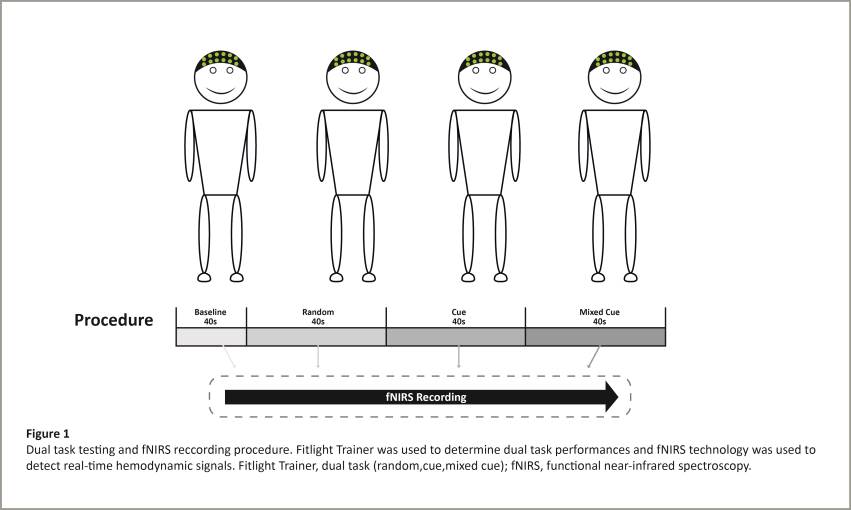
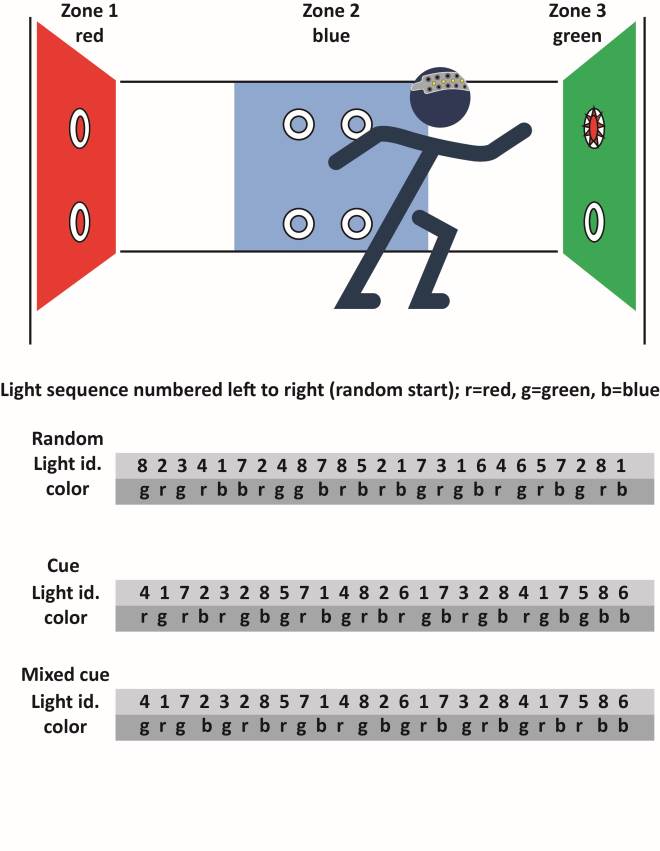
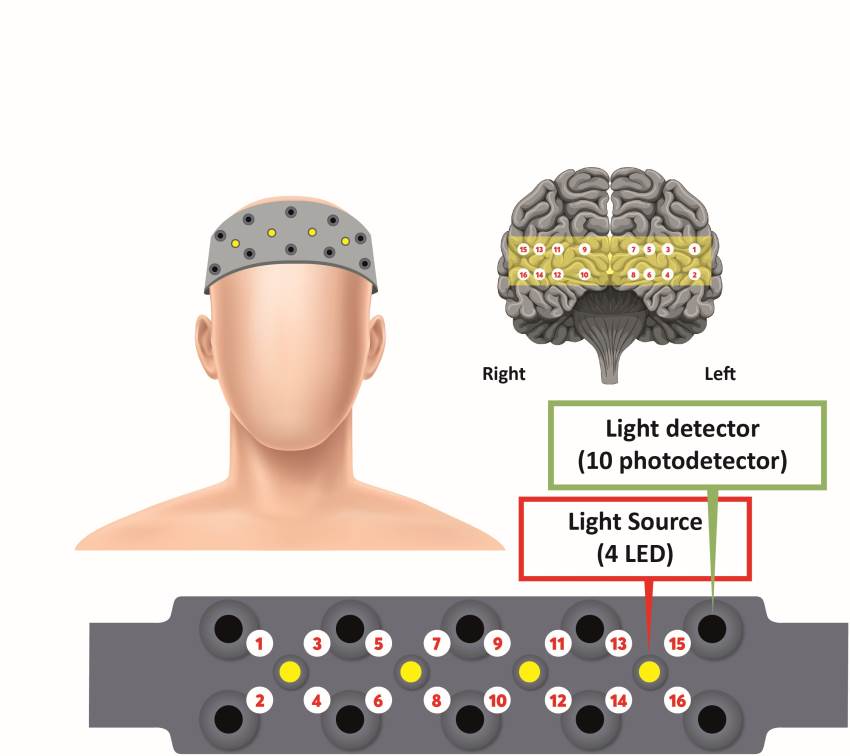
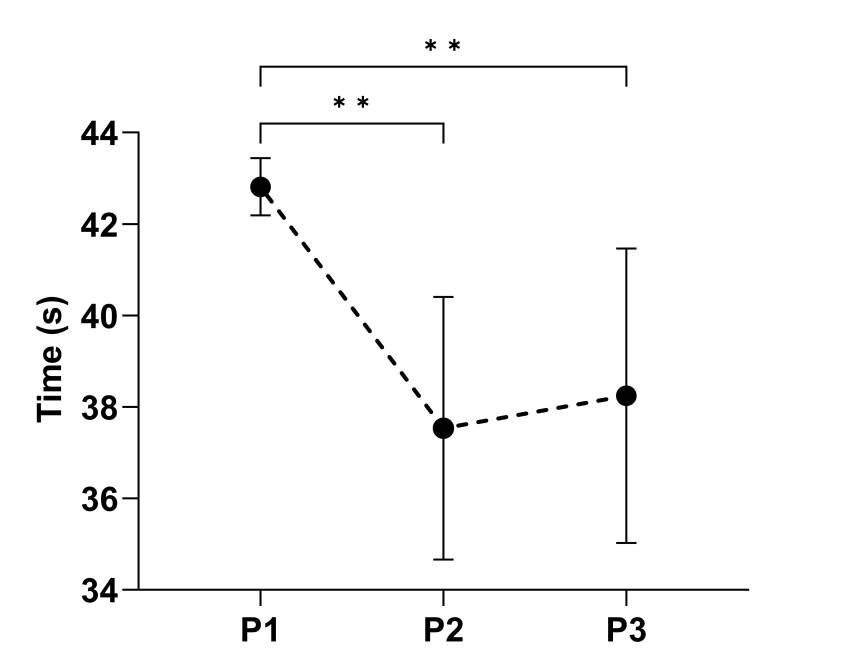
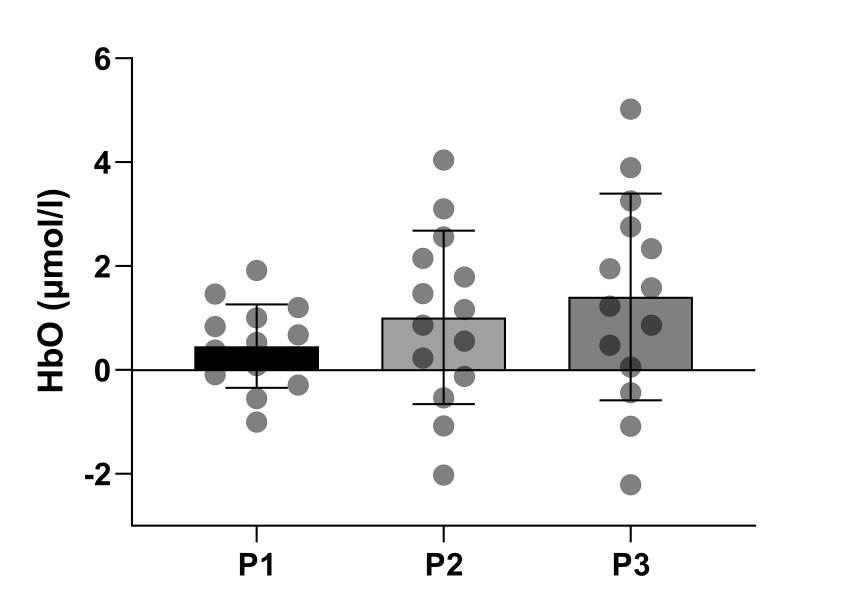
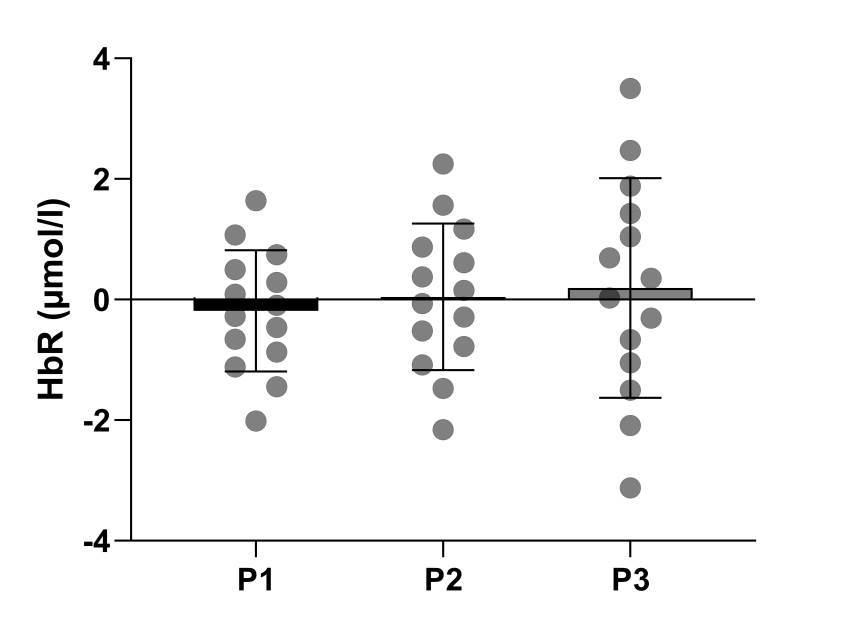
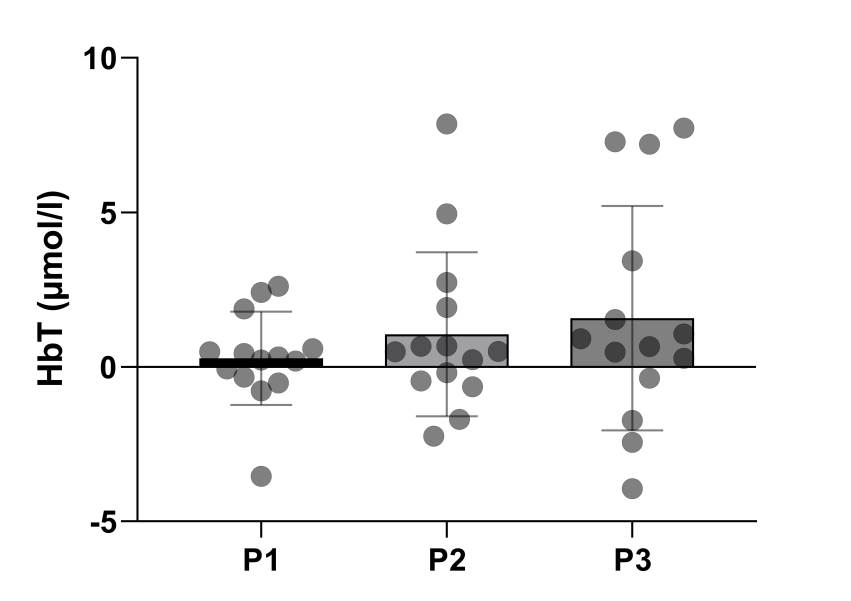
Aim: The efficient use of the prefrontal cortex (PFC) plays a crucial role in athletes' mastery of technical and tactical skills, enabling them to perform at a high level by making sound decisions during competitive encounters. However, the effects of dual-task paradigms on the PFC in athletes remain unclear in the literature. The aim of this study was to investigate the effects of dual-task (cognitive + motor) paradigms presented at varying levels of difficulty on PFC hemodynamic responses. Methods: This study included 14 athletes (mean age = 12 ± 1.56 years), randomized to the "Dual Task" paradigm (P1: motor task; P2: cue task; P3: complex cue task). Dual task performance was measured using the Fitlight system, where participants extinguished 25 lights at varying difficulty levels. In P1, participants extinguished randomly lit lights; in P2, they did so faster as the next light appeared in the same color region; in P3, a more complex cue indicated the light region, requiring altered motor control. Hemodynamic responses in the prefrontal cortex (HbO, HbR, HbT) were assessed using fNIRS during task performance. Results: Significant differences were observed in the competition time of the test between the P1 and P2 tasks (p < 0.001), as well as between the P1 and P3 tasks (p < 0.001). fNIRS data demonstrated a higher level of cortical activation in the prefrontal cortex during the P3 task compared to other tasks; however, this difference was not statistically significant (p = 0.257). A strong and statistically significant positive correlation was identified between the hemodynamic responses and the P1, P2, and P3 tasks (p < 0.001). Conclusion: Task protocols with higher cognitive load resulted in an increase in HbO, HbR, and HbT values, which were proportional to task difficulty in prefrontal activation. Keywords: dual-task, cognitive load, prefrontal cortex, fNIRS
Conflict of interest : The authors declare that they have no conflict of interest.
Mevlana Tıp Bilimleri 2025, Vol5, Issue3 E-ISSN: 2757-976X
Received : , Accepted : , Published Online :
References
1. Goh HT, Ewing S, Marchuk D, Newton A, Nyangani I. Facilitation of supplementary motor area excitability improves dual-task walking in young adults. Neuroscience Letters. 2019;698:1–6.
2. Byrne MD, Anderson JR. Serial modules in parallel: the psychological refractory period and perfect time-sharing. Psychological review. 2001;108(4):847.
3. Pashler H. Dual-task interference in simple tasks: data and theory. Psychological bulletin. 1994;116(2):220.
4. Strobach T, Frensch P, Müller HJ, Schubert T. Testing the limits of optimizing dual-task performance in younger and older adults. Frontiers in Human Neuroscience. 2012;6:39.
5. Paas FG, Van Merriënboer JJ. Variability of worked examples and transfer of geometrical problem-solving skills: A cognitive-load approach. Journal of educational psychology. 1994;86(1):122.
6. Hoang I, Ranchet M, Derollepot R, Moreau F, Paire-Ficout L. Measuring the cognitive workload during dual-task walking in young adults: a combination of neurophysiological and subjective measures. Frontiers in human neuroscience. 2020;14:592532.
7. Gabbett TJ, Abernethy B. Dual-task assessment of a sporting skill: influence of task complexity and relationship with competitive performances. Journal of Sports Sciences. 2012 Dec;30(16):1735–45.
8. Schaefer S, Amico G. Table tennis expertise influences dual-task costs in timed and self-initiated tasks. Acta Psychologica. 2022;223:103501.
9. Jansen P, Lehmann J, Van Doren J. Mental rotation performance in male soccer players. PloS one. 2012;7(10):e48620.
10. Fleddermann MT, Heppe H, Zentgraf K. Off-court generic perceptual-cognitive training in elite volleyball athletes: Task-specific effects and levels of transfer. Frontiers in psychology. 2019;10:1599.
11. Peng P, Barnes M, Wang C, Wang W, Li S, Swanson HL, et al. A meta-analysis on the relation between reading and working memory. Psychological bulletin. 2018;144(1):48.
12. Kreitz C, Furley P, Memmert D, Simons DJ. The Influence of Attention Set, Working Memory Capacity, and Expectations on Inattentional Blindness. Perception. 2016 Apr;45(4):386–99.
13. Lucia S, Aydin M, Di Russo F. Sex differences in cognitive-motor dual-task training effects and in brain processing of semi-elite basketball players. Brain Sciences. 2023;13(3):443.
14. Jueptner M, Stephan KM, Frith CD, Brooks DJ, Frackowiak RSJ, Passingham RE. Anatomy of Motor Learning. I. Frontal Cortex and Attention to Action. Journal of Neurophysiology. 1997 Mar 1;77(3):1313–24.
15. Duschek S, Heiss H, Schmidt MFH, Werner NS, Schuepbach D. Interactions between systemic hemodynamics and cerebral blood flow during attentional processing. Psychophysiology [Internet]. 2010 Apr [cited 2025 Jan 27]; Available from: https://onlinelibrary.wiley.com/doi/10.1111/j.1469-8986.2010.01020.x
16. Jelsma LD, Geuze RH, Fuermaier ABM, Tucha O, Smits-Engelsman BCM. Effect of dual tasking on a dynamic balance task in children with and without DCD. Human movement science. 2021;79:102859.
17. Kuijpers R, Smulders E, Groen BE, Smits-Engelsman BC, Nijhuis-van der Sanden MW, Weerdesteyn V. The effects of a visuo-motor and cognitive dual task on walking adaptability in children with and without Developmental Coordination Disorder. Gait & Posture. 2022;95:183–5.
18. Ferrari M, Quaresima V. A brief review on the history of human functional near-infrared spectroscopy (fNIRS) development and fields of application. Neuroimage. 2012;63(2):921–35.
19. Logothetis NK, Pauls J, Augath M, Trinath T, Oeltermann A. Neurophysiological investigation of the basis of the fMRI signal. nature. 2001;412(6843):150–7.
20. Carius D, Herold F, Clauß M, Kaminski E, Wagemann F, Sterl C, et al. Increased Cortical Activity in Novices Compared to Experts During Table Tennis: A Whole-Brain fNIRS Study Using Threshold-Free Cluster Enhancement Analysis. Brain Topogr. 2023 Jul;36(4):500–16.
21. Mirelman A, Maidan I, Bernad-Elazari H, Nieuwhof F, Reelick M, Giladi N, et al. Increased frontal brain activation during walking while dual tasking: an fNIRS study in healthy young adults. J NeuroEngineering Rehabil. 2014;11(1):85.
22. Shaw EP, Rietschel JC, Hendershot BD, Pruziner AL, Miller MW, Hatfield BD, et al. Measurement of attentional reserve and mental effort for cognitive workload assessment under various task demands during dual-task walking. Biological psychology. 2018;134:39–51.
23. Lucia S, Bianco V, Boccacci L, Di Russo F. Effects of a cognitive-motor training on anticipatory brain functions and sport performance in semi-elite basketball players. Brain Sciences. 2021;12(1):68.
24. Faul F, Erdfelder E, Buchner A, Lang AG. Statistical power analyses using G*Power 3.1: Tests for correlation and regression analyses. Behavior Research Methods. 2009 Nov;41(4):1149–60.
25. Salzman T, Aboualmagd A, Badawi H, Tobón-Vallejo D, Kim H, Dahroug L, et al. Prefrontal cortex involvement during dual-task stair climbing in healthy older adults: an fNIRS study. Brain sciences. 2021;11(1):71.
26. Oldfield RC. The assessment and analysis of handedness: the Edinburgh inventory. Neuropsychologia. 1971;9(1):97–113.
27. Laessoe U, Grarup B, Bangshaab J. The use of cognitive cues for anticipatory strategies in a dynamic postural control task-validation of a novel approach to dual-task testing. PloS one. 2016;11(8):e0157421.
28. Şimşek D, Bıdıl S, Özböke C. Cognitive-Motor Dual-Task Ability of Elite Badminton Athletes. Spor Bilimleri Dergisi. 2023;34(1):32–41.
29. Hirsch P, Nolden S, Declerck M, Koch I. Common cognitive control processes underlying performance in task-switching and dual-task contexts. Advances in cognitive psychology. 2018;14(3):62.
30. Herold F, Wiegel P, Scholkmann F, Müller NG. Applications of functional near-infrared spectroscopy (fNIRS) neuroimaging in exercise–cognition science: a systematic, methodology-focused review. Journal of clinical medicine. 2018;7(12):466.
31. Scholkmann F, Tachtsidis I, Wolf M, Wolf U. Systemic physiology augmented functional near-infrared spectroscopy: a powerful approach to study the embodied human brain. Neurophotonics. 2022;9(3):030801–030801.
32. Ji Z, Feng T, Mei L, Li A, Zhang C. Influence of acute combined physical and cognitive exercise on cognitive function: an NIRS study. PeerJ. 2019;7:e7418.
33. Ekkekakis P. Illuminating the black box: investigating prefrontal cortical hemodynamics during exercise with near-infrared spectroscopy. Journal of Sport and Exercise Psychology. 2009;31(4):505–53.
34. Hoshi Y. Functional near-infrared spectroscopy: current status and future prospects. Journal of biomedical optics. 2007;12(6):062106–062106.
35. Gagnon C, Desjardins-Crépeau L, Tournier I, Desjardins M, Lesage F, Greenwood CE, et al. Near-infrared imaging of the effects of glucose ingestion and regulation on prefrontal activation during dual-task execution in healthy fasting older adults. Behavioural Brain Research. 2012;232(1):137–47.
36. Wu J, Liu T, Huang J, Han W. The effects of exercise fatigue on prefrontal and motor activations as measured by near-infrared spectroscopy. NeuroReport. 2017;28(17):1134–8.
37. González‐Alonso J, Dalsgaard MK, Osada T, Volianitis S, Dawson EA, Yoshiga CC, et al. Brain and central haemodynamics and oxygenation during maximal exercise in humans. The Journal of Physiology. 2004 May;557(1):331–42.
38. Nishimoto R, Fujiwara S, Kutoku Y, Ogata T, Mihara M. Effect of dual-task interaction combining postural and visual perturbations on cortical activity and postural control ability. Neuroimage. 2023;280:120352.
39. Holtzer R, Mahoney JR, Izzetoglu M, Izzetoglu K, Onaral B, Verghese J. fNIRS study of walking and walking while talking in young and old individuals. Journals of Gerontology Series A: Biomedical Sciences and Medical Sciences. 2011;66(8):879–87.
40. Wu J, Qiu P, Lv S, Chen M, Li Y. The effects of cognitive-motor dual-task training on athletes’ cognition and motor performance. Frontiers in Psychology. 2024;15:1284787.
41. Mancı E, Herold F, Günay E, Güdücü Ç, Müller NG, Bediz CŞ. The influence of acute sprint interval training on the cognitive performance of male basketball players: an investigation of expertise-related differences. International Journal of Environmental Research and Public Health. 2023;20(6):4719.
42. Ou Z, Ding Q, Yao S, Zhang L, Li Y, Lan Y, et al. Functional near‐infrared spectroscopy evidence of cognitive–motor interference in different dual tasks. Eur J of Neuroscience. 2024 Jun;59(11):3045–60.
 Research Article
 View as PDF
 Keywordsdual-task, cognitive load, prefrontal cortex, fNIRS