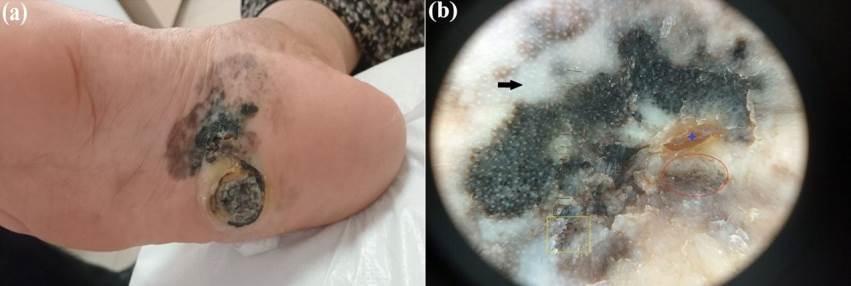
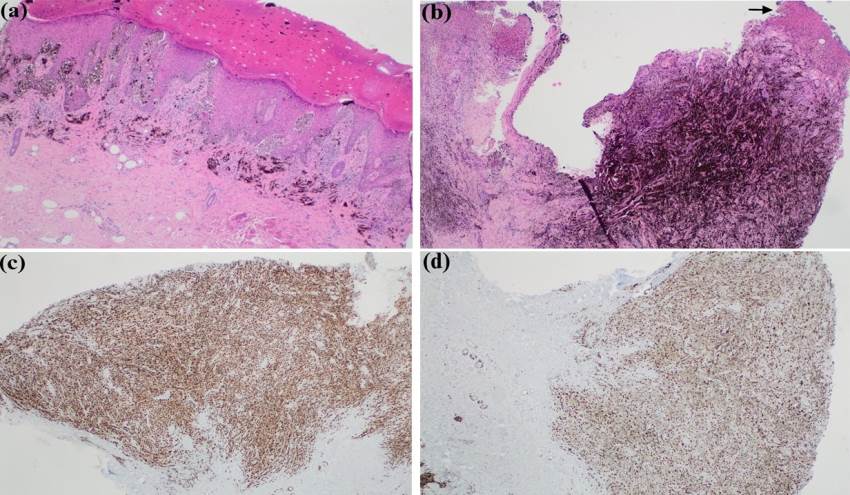
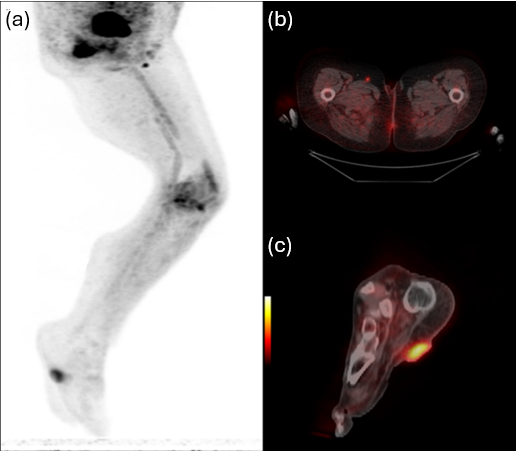
Acral lentiginous melanoma (ALM) is the rarest subtype of cutaneous melanoma, primarily affecting the palms, soles, and nail units. Unlike other melanoma subtypes, ALM is thought to be associated with mechanical stress and chronic trauma rather than ultraviolet exposure. In elderly patients, inadequate routine examination of the plantar region may lead to delayed diagnosis and advanced-stage presentation. We report the case of a 74-year-old female who presented with a painful lesion on the right plantar foot that developed following a thorn injury. Dermoscopic examination revealed diffuse variegated pigmentation, peppering, atypical dots and globules, ulceration, and regression areas. Histopathologic evaluation confirmed the diagnosis of ALM, with a Breslow thickness of 15 mm. Positron emission tomography/computed tomography (PET/CT) demonstrated increased 18F-fluorodeoxyglucose (FDG) uptake in the right inguinal-femoral lymph nodes; however, histopathologic examination of the excised lymph nodes showed no evidence of malignancy. This case underscores the clinical, dermoscopic, and histopathologic features of ALM and highlights the importance of careful plantar examination for early diagnosis, particularly in elderly patients. Key words: plantar melanoma, acral lentiginous melanoma, cutaneous oncology, melanoma diagnosis
Conflict of interest : The authors declare that they have no conflict of interest.
Mevlana Tıp Bilimleri 2026, Vol6, Issue2 E-ISSN: 2757-976X
Received : , Accepted : , Published Online :
References
1. Wada M, Ito T, Tsuji G, et al. Acral lentiginous melanoma versus other melanoma: A single-center analysis in Japan. J Dermatol. 2017;44(8):932-938.
2. Bristow IR, Acland K. Acral lentiginous melanoma of the foot and ankle: A case series and review of the literature. J Foot Ankle Res. 2008;1:11.
3. Goydos JS, Shoen SL. Acral Lentiginous Melanoma. Cancer Treat Res. 2016;167(321):9.
4. Lino-Silva LS, Zepeda-Najar C, Salcedo-Hernández RA, et al. Acral Lentiginous Melanoma: Survival Analysis of 715 Cases. J Cutan Med Surg. 2019;23(1):38-43.
5. Darmawan CC, Jo G, Montenegro SE, et al. Early detection of acral melanoma: A review of clinical, dermoscopic, histopathologic, and molecular characteristics. J Am Acad Dermatol. 2019;81(3):805-812.
6. Liu XK, Li J. Acral lentiginous melanoma. Lancet. 2018;391(10137): e21.
7. Minagawa A, Omodaka T, Okuyama R. Melanomas and Mechanical Stress Points on the Plantar Surface of the Foot. N Engl J Med. 2016;374(24):2404-6.
8. Situm M, Buljan M, Kolić M, et al. Melanoma--clinical, dermatoscopical, and histopathological morphological characteristics. Acta Dermatovenerol Croat. 2014;22(1):1-12.
9. Nakamura Y, Fujisawa Y. Diagnosis and Management of Acral Lentiginous Melanoma. Curr Treat Options Oncol. 2018;19(8):42.
10. Swetter SM, Johnson D, Albertini MR, et al. NCCN Guidelines Insights: Melanoma: Cutaneous, Version 2.2024. J Natl Compr Canc Netw. 2024;22(5):290-298.
11. Matteucci M, Pesce A, Guarino S, et al. Rethinking Lymphadenectomy in Cutaneous Melanoma: From Routine Practice to Selective Indication: A Narrative Review. Medicina (Kaunas). 2025;61(9):1722.
12. Michielin O, van Akkooi ACJ, Ascierto PA, et al. Cutaneous melanoma: ESMO Clinical Practice Guidelines for diagnosis, treatment and follow-up. Ann Oncol. 2019;30(12):1884-1901.
13. Chen KC, Chu PY, Li CY, et al. Diagnostic value of 18 F-fluoro-2-deoxyglucose positron emission tomography/computed tomography imaging in acral melanoma-predominant Asian patients. J Chin Med Assoc. 2023;86(11):975-980.
14. Garbe C, Amaral T, Peris K, et al. European Association of Dermato-Oncology (EADO), the European Dermatology Forum (EDF), and the European Organization for Research and Treatment of Cancer (EORTC). European consensus-based interdisciplinary guideline for melanoma. Part 2: Treatment- Update 2024. Eur J Cancer. 2025;215:115153.



 Keywords